


The Game Business Live takes place in Los Angeles on Monday, June 8. We will be interviewing game industry veterans Laura Miele, Jason Rubin and Matthew Ball live on stage. Tickets are available now.
Listen now on Apple, Spotify or YouTube
In This Edition,
PlayStation’s Christian Svensson on…
Getting games on PS5
The rise of China and South Korea
Funding for indie games
Why the future is very bright
There are around 10,000 developers and publishers that work with PlayStation today.
The platform holder has five internal teams devoted to helping them, from providing dev kits and sharing best practices, to PR, marketing and even funding.
Sony says it’s a big investment. It’s one of the reasons it charges a 30% commission fee on games sold via its store. Attracting and supporting game developers on PS5 is costly.
But does it need to keep doing it? Xbox has scaled back its console business. Nintendo delivers mixed results for third-parties. And although Steam is a major platform, it’s also a saturated one that speaks to a slightly different audience. PlayStation is such a clear leader in this space, does it need to invest so much in external teams?
“If you look at PlayStation’s history, from the beginning we’ve been a very third-party focused ecosystem,” says Christian Svensson, VP of second and third-party content ventures and strategic initiatives at Sony Interactive Entertainment.
“If you talk to [SIE CEO] Nishino-san, who has a very product-led background, he’ll say, ‘PlayStation is just a plastic box without content.’ And third-parties are the lion’s share of the content. So, it is critical that we continue to lean in and drive, and be ambitious and bring new voices to the platform. If we ever stop doing that, the industry will stop growing. We have, as an industry leader, a responsibility to continue to drive and push and to grow the whole industry, not just our own business.”
Our chat with Svensson follows a question from one of our readers about working with PlayStation. How do you get a game on PS5? How do you get selected for PlayStation Plus? What about a slot in the State of Play broadcasts? Is there any funding available?
In today’s The Game Business, Svensson answers those questions, plus a lot more. And he tells us why he’s “super optimistic” about the future of the industry.
You can watch or listen to the conversation above, or check out our write-up below.
It starts with a form…
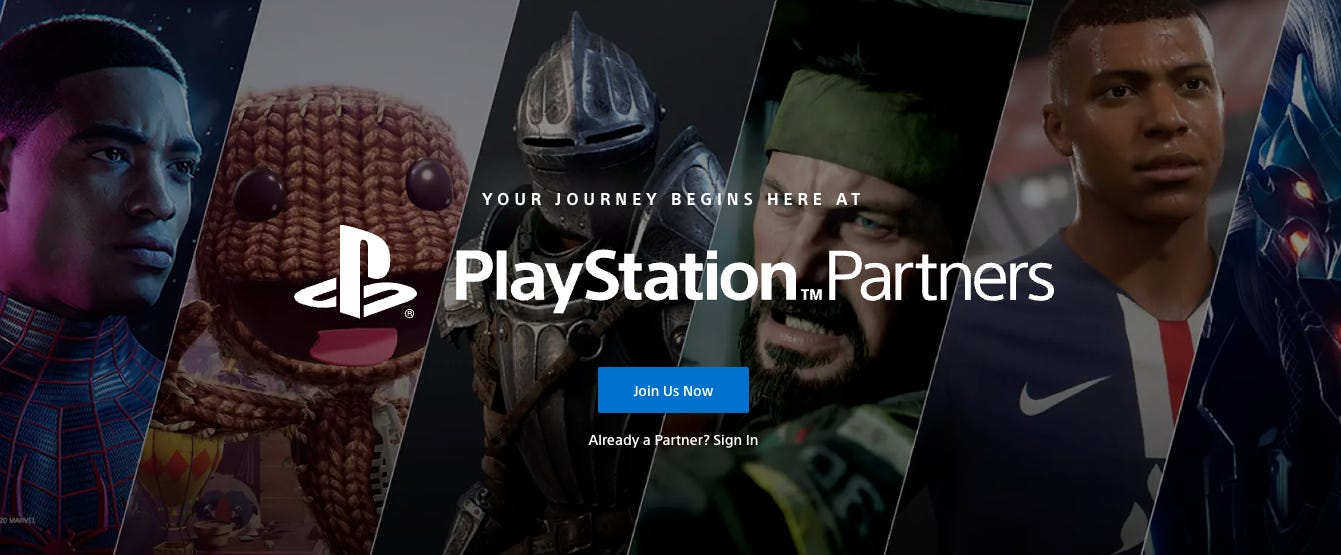
The journey for prospective PlayStation developers begins at partners.playstation.net. There they’ll find a form where they detail who they are, what they do and what they’re making.
“It is not an onerous experience,” insists Svensson.
“Once you’re registered, we have an ingestion form, where you can tell us more about your project, when’s it coming, you can submit pitch decks, trailers, builds, all sorts. And our Partner Development team actually goes through that.”
Doing this means that PlayStation is now tracking you.
“If we aren’t aware of your game, the opportunities on how we can work with you are very limited,” he adds. “This is the first triage point for how we manage those 10,000 partners with a very small team. [It means] we know what’s coming and can elevate to other teams across the business for where there are opportunities to engage.
“You can make asks of us. And, as we’re doing things like programming State of Play, as we’re doing things like funding opportunities, or grant opportunities, or participation in our indie days or any other content communications pieces, those are things that start [with that form].”
That includes PlayStation Plus, too. Although Svensson stresses that PlayStation doesn’t put many brand-new games into the subscription service.
“We do them largely for indies, and there’s probably between four and six a year that we focus on,” he says. “But again, it starts with our content intelligence piece and then flows from there.”
Finally, once the teams have signed up, they’re eligible for a free dev and test kit.
Funding isn’t core to what Sony does (but it does offer it)
For smaller developers, Svensson’s teams focus a lot on discovery, education and marketing. They host indie breakfasts at GDC and Gamescom, where they present to around 75 people and answer questions over coffee and pastries. And indie games frequently feature on the PlayStation blog and in State of Play broadcasts.
“We put indies on the same stage as our very biggest AAA partners,” Svensson says. “We don’t think them as less than, we think of them as an amazing complement to the breadth and depth story that needs to exist on our platform.”
But what about the thing that indie developers need most in 2026… money.
“On the funding side, I don’t want to diminish what we do,” Svensson begins. “We have funded either wholly or partially more than 120 projects this generation. But that is not the core of what we do. And that’s not counting Hero projects, by the way, which are separate [more on Hero projects below].
“We [also] have a small diversity set of funds that we issue every year. Again, it comes through the process of that initial submission. And we have a very small non-recoupable indie fund, which we deliver to have some content come to PlayStation that might not otherwise get to us.”
Sponsor Message
GameDiscoverCo Pro: unprecedented insight into PC/console game data

Want actionable data and real takeaways when planning and executing your PC & console game strategy? The GameDiscoverCo Pro data set, created by the folks behind the popular newsletter and licensed by 90+ game publishers, platforms & devs worldwide, now includes:
Steam wishlist & player insights: who’s trending, how, and why?
Steam ‘deep dive’ data: from player overlap to review sentiment & demographics.
Console data: key insights across PlayStation, Xbox and Switch eShop.
If you want to try the tool for yourself, we have a free demo of GDCo Pro available right now - just reach out to us and we’ll add you to our platform to check it out.
The Hero projects are five to ten-year visions

PlayStation has been investing in new markets via its Hero Projects. Specifically, the company is helping to fund games from China, India, North Africa and the Middle East.
The console business is relatively small in these territories. China is big on mobile and PC, India is a mobile-first market, while North Africa and the Middle East are also heavily mobile (but some PC).
Svensson explains: “We need to build a community of developers that have experience and understanding of what it means to make games for PlayStation.
“This is a long-term play. There’s not a commercial near-term angle. This is growing the dev community first, get local content that hopefully resonates with local audiences, which helps grow the player community. And then it’s about, how do we bring regionally relevant voices to our globally, massively engaged audience? How do we expose that global audience to themes and content that they may not have had access to before?
“But these are five, 10-plus year visions for ecosystem growth, both from a supply side and a player side. “
Svensson says PlayStation has made big strides in China since the China Hero Project started in 2018.
“India, we’re a little bit further behind,” he adds. “The talent pool is there in a different way. We still have a lot of work to do, but its scale is promising. And Middle East and North Africa are a little bit further behind India in terms of the talent pipeline and experience.”
PlayStation shipped its first India Hero Project title last month called Fishbowl, but it’s not yet released a game from its MENA Hero Project.
“It’s an ongoing thing,” he says. “We’ve done three waves of China Hero Projects and we’re sourcing and getting ready for a fourth wave. We’re bringing on outside investment to help scale what we’re doing there. Similarly, we’re bringing in outside investment in Middle East and North Africa to scale some of the efforts that we’re making there. [We’re focused on] these three regions in the near term. Budgetarily, the investments are not insignificant, and we’re going to stay on the course while we continue to grow those regions.”
China and South Korea are exciting PlayStation
Svensson’s teams work with developers globally, and when we asked what’s exciting him in 2026, he immediately pointed to what’s going on in China and South Korea.
“The pace at which I’m seeing teams in China and South Korea move are astonishing,” he says. “The scale and the responsiveness in their approach, it’s something that we’re not necessarily seeing from some of our Western or even Japanese teams. It’s really impressive. The content that’s also coming from there is very different than the stuff that we’ve seen before, at least on PlayStation.
“It’s been exciting to see the evolution of what those teams are working on, and how they continually push each other. As large as the dev community is, they all know each other and they all talk. It’s interesting to see what their trends and trajectories are relative to Western dev communities. There’s a different dynamic there.”
PlayStation has no ‘genre plan’
PlayStation isn’t looking for specific game genres, Svensson insists.
“We want to see games with strong, original creative visions. There’s no genre plan. That doesn’t exist. We want to see strong points of view and strong visions. In the case of things that we fund, we also want to understand that the production discipline is there. That they’re resourced correctly and they’re thoughtful about how they’re planning their teams. What is the right scale of the team to achieve the vision? Are they being too ambitious? Is their budget too big? Is their timeline too long? Or is it the other way?
“And then it’s understanding a pathway to market. We work with so many developers that are great at making games, but they grossly underestimate the work it takes to stand out, to create resonance, to build community. Or they think about it way too late. They’re so heads down on making the game that they’ve missed the commercialization piece of the puzzle. And that’s a problem.”
PlayStation is wary of giving partners a heads-up on first-party launch dates

One thing I was interested to find out is whether Sony helps studios with their release windows.
For example, PlayStation is releasing Marvel’s Wolverine on September 15. So, before that date was announced, if a developer had come to PlayStation with a similar release timing, would they have said anything?
“Air traffic control we have to be very careful with,” he explains. “Games move all the time. You could tell a partner, ‘Hey, you might not want to be in the first half of September’, so they set their game in October… but then that big first-party game moves to that October date. You have to be very careful with that kind of telegraphing. It can come back to bite you.”
“We as an industry should be super optimistic”
Svensson and his five teams know what’s coming. They’re helping new studios and working on games that might define the future of the business. Therefore, his perspective on where the industry is heading might be useful.
“In the future there’s going to be more touch points with players than ever, and figuring out how to navigate the number of devices, the number of audience segments, and finding your audience for your game, that’s going to continue to be where the challenge is,” he says.
“I’m in an incredibly privileged position to have amazing visibility into what games will be for the next 3, 4, 5 years. I literally cannot explain to you… last year was an amazing year for games. This year will be even better. Next year will be better still. The trajectory of content is unbelievably positive. And we as an industry should be super optimistic about where we’re going in spite of the headwinds.”
As we’ve discussed on The Game Business before, the challenges the industry is facing today is based on decisions made five years ago. And the decisions that are being made today won’t necessarily be seen for another half a decade.
“And obviously the decisions we’re making now take into account where we are at this moment,” Svensson concludes “We’re anticipating where we’re going to be. There are no dire times for the industry ahead as far as I’m concerned. Very smart decisions are being made by our partners and by platforms. Be more comfortable than you think you should be.”
That’s it for today. We’ll be back on Thursday where we will be joined by one of the world’s most successful video game VCs. Until then, thank you for reading.


