


Listen now on Apple, Spotify or YouTube
In This Edition,
Impact of the physical switch-off
The risk of $1,000 game consoles (podcast only)
We speak to Gamescom!
Hello there!
Welcome back to another bumper edition of The Game Business.
This week, we return to the topic around PlayStation’s decision to stop manufacturing PlayStation discs. Rather than debate the decision, we’ve turned to our friends at Ampere to highlight the PS5 games that still sell well physically, and the countries where boxed games remain a strong distribution channel.
And then we chat about how publishers can manage the transition, with just under 18 months to go.
We also interview Gamescom about this year’s show, democracy and the European games sector. You can listen to all this on today’s Show above (featuring Ampere’s Piers Harding-Rolls and Gamescom’s Felix Falk). Or check out the key data, analysis and quotes below.
Enjoy!
Publishers need to prepare players for an all-digital future
In January 2028, PlayStation will stop manufacturing discs.
The data shows that video games is primarily a digital business today. However, it can vary by title, location and platform.
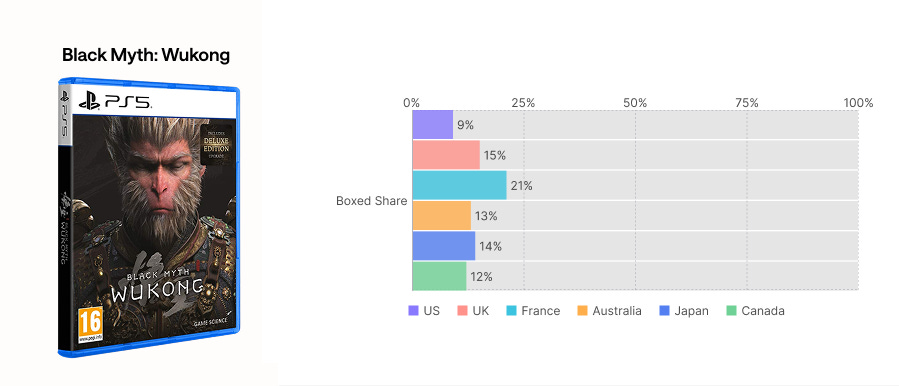
Our friends at Ampere Analysis looked at five PS5 games for us: Resident Evil: Requiem, Assassin’s Creed Shadows, Astro Bot, Black Myth: Wukong and Helldivers 2. It analysed what percentage of sales were made via physical retail, and broke that down by territory.
This data covers PS5 game sales only, and is unit sales up until the end of June 2026.
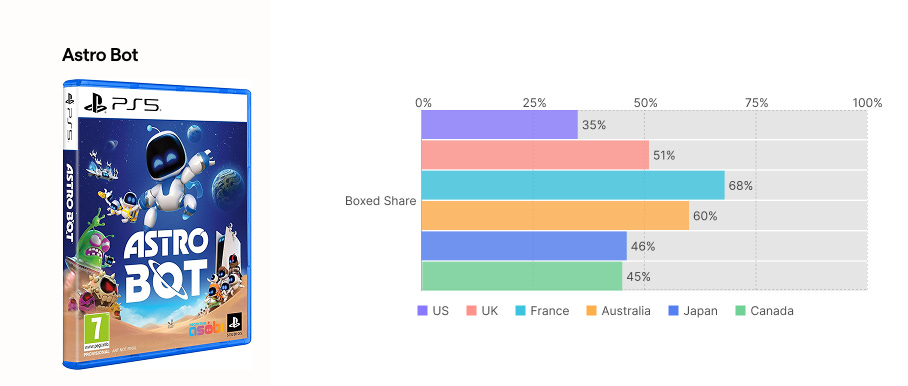
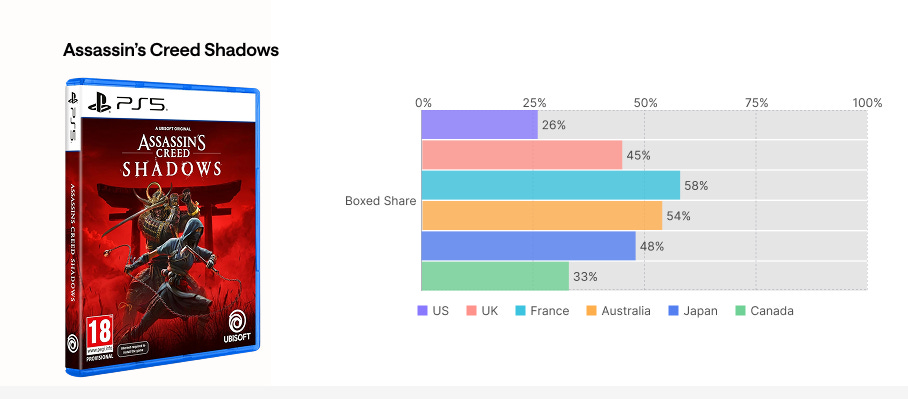
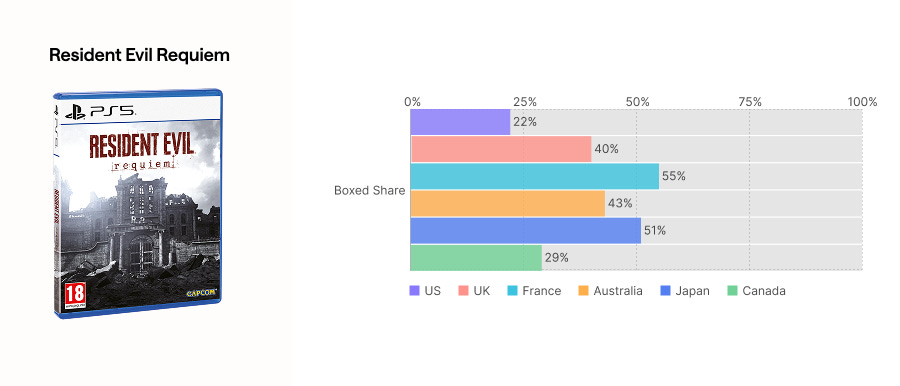
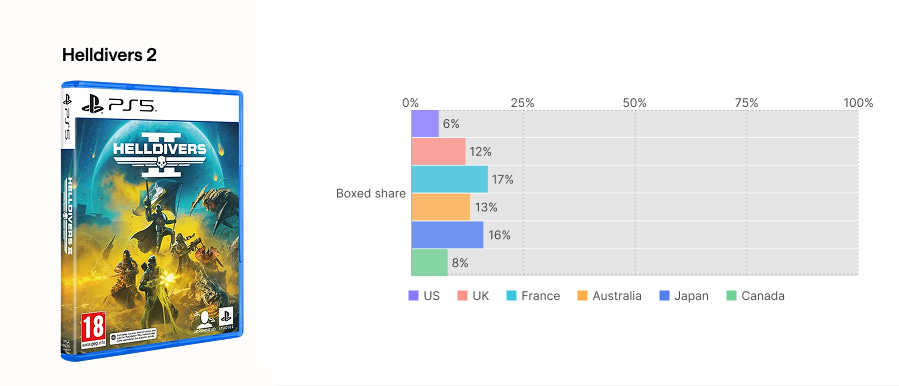
Family games like Astro Bot, potentially because they’re often bought at Christmas and birthday presents, are very strong in the physical space. More story-driven action adventure games such as Assassin’s Creed and Resident Evil also have a large audience of physical buyers.
Meanwhile, more online-centric games, shooters and RPGs, such as Helldivers 2 and Black Myth: Wukong, have a much smaller audience that choose to buy the boxed version.
Things also differ significantly by territory. The US is a very digital-centric market, but France is still heavily into physical. Countries like Australia, UK and Japan also have a strong boxed games retail industry.
Publishers like Capcom and Ubisoft, which make games with a strong cohort of physical buyers, will need to start preparing their fans for the physical switch-off.
Grand Theft Auto 6 is an ally in this objective. The fact the game doesn’t come in a disc will help with the education process with a large base of customers.
Nevertheless, game companies will still want to work with physical retail, including creating digital code-in-a-box products, to limit the risk of losing customers during this transition. There will be an expectation on Sony to help publishers with this, and the platform holder will also want to protect its own games (such as Astro Bot and Spider-Man). Therefore, we should expect PlayStation to develop best practices to take physical players through the transition to digital.
Some publishers will be able to start encouraging its fans to switch to digital now. For example, Capcom has a new Resident Evil game out next year, before the physical switch-off. We know from the data that the last Resident Evil (Requiem) had a strong audience of physical buyers, so the publisher will want to develop incentives to transition those users to digital with this next release.
Ultimately, the aim for the industry is to get into a position where all PlayStation game buyers in 2028 are willing to buy digitally, and know how to do it.
You can hear more on the subject in today’s edition of The Game Business Show.
Sponsored Message
Authentic, data-led engagement

Keywords Studios is the games industry’s end-to-end partner, with 13,000 people across 26 countries helping studios build, launch and support games at global scale. Supercharged by technology and shaped by long-term partnership, Keywords Studios connects specialist expertise around the player experience.
For Marketing and Player Engagement, that means helping studios understand players more clearly and build stronger relationships. From player support, trust and safety to community insight and engagement strategy, Keywords Studios helps teams respond to player needs with more relevance, care and impact.
Gamescom could sell more physical tickets, but doesn’t want to

Gamescom returns to Cologne next week, and the event is sold out of exhibitor space for the first time.
The firm is now looking to expand its space for 2027, but organizer Felix Falk says it isn’t expecting to increase the number of people coming into the show.
“We don’t want to fit too many people,” he told us. “Gamescom is not only about people on site. Last year we had 357,000 people. It doesn’t really matter if it’s 10,000 more or less, because most of the growth has been in the digital reach. We have massive reach in people tuning in from everywhere in the world, which is millions of people. That’s more important than people on site.
“Of course, we always try to find the good balance between as many people as possible, but not limiting the quality of stay. In 2019, we had a situation where we had too many people. The complaints were going up, and people were saying it was too full and too busy, and it starts to feel squeeze. So, we went down from there, and we give less tickets into the market. We could give more, we have two days already sold out, but it’s important for us that the day is perfect for everybody who is there, and it gets multiplied into the world by digital.”
Gamescom doubles down on democracy ahead of German president visit

German president Frank-Walter Steinmeier is heading to Gamescom next Thursday, as the trade and consumer show makes democracy a core theme for the 2026 event.
The event will promote democratic engagement via various events, fundraising activities, and the Gamescom Congress, which will feature discussions on the topic.
“For the first time, the highest represented of Germany, the president, is attending Gamescom,” Gamescom’s Felix Falk told The Game Business.
“That’s on the Gamescom Thursday, where we talk about the potential for games for democracy. In broader society and general media, there is a misunderstanding around games. You may remember how often there are articles about toxic behaviour in games, with a very narrow view on this community. We want to tell people that it’s especially gamers and the gaming industry who have a great potential for things like democracy.
“In our times right now, such as with all the problems GDC has, it’s so important to show where we are standing, and why diversity, and democracy, is so important for a successful game industry. And how we and our community can help with that democracy, because what studies have shown is that activism and engagement of the community is much higher than the rest of society. Gamers are more willing to donate, to collect donations, to sign petitions, to demonstrate, and to engage for things like democracy.”
Check out more from our interview with Felix in this week’s edition of The Game Business Show.
Meanwhile…
Human: Fall Flat development leaders Sitara Shefta and Will Dudley have formed a new studio called Pretty Cool Games. The UK-based, fully remote studio received start-up money from Chinese developer Hypergryph, which is best known for the RPG Arknights: Endfield.
As revealed yesterday, Arkane Studios leaders Harvey Smith, Ben Horne and Ricardo Bare have formed Black Pony Immersive. It is working on a single-player immersive sim game.
Deus Ex, Thief and Epic Mickey creator Warren Spector has announced his retirement after over forty years in game development.
The US Senate Judiciary Subcommittee on Crime and Counterterrorism is investigating Roblox, accusing the platform of prioritizing ‘revenue and engagement’ over child safety. Roblox denies this.
Netflix is closing Night School Studio, alongside Helsinki-based Moonloot Games. Night School made recent horror hit Unhinged.
2K Games has launched Small Axe Studios. The new developer is led by EA Sports veterans and is based in the same city: Vancouver, Canada. The team is building the ‘next blockbuster sports franchise’ and wants to ‘redefine the future of sports video games’.
Nexon saw Q2 revenue rise 2% to $761 million, driven by continued success for Arc Raiders and MapleStory. Arc Raiders now has hit 16.3 million sales after selling a further 800,000 units during the quarter.
Mattel has announced the formation of Mattel Game Studios, a global development organisation that will create games based on the company’s IP. It follows the acquisition of Mattel163 in February, which was previously a joint venture with NetEase. The new group will oversee existing mobile games, and upcoming titles coming to Roblox and Fortnite.
Pokémon spin-off Pokopia has now sold five million copies worldwide.
CD Projekt has made some cuts to its Project Sirius team, which is the new multiplayer spin-off to The Witcher series. Nine employees have been cut, with a further nine to be offered roles elsewhere. The cuts were to ‘reflect the project’s needs at this stage of development’.
That’s it for today’s edition of The Game Business. Next week, we have our big CEO interview with Unity, so join us for that. Until then, thank you for reading.


