


Listen now on Apple, Spotify or YouTube
In This Edition
- Does GDC have a future?
- Revealed: Industry views on AI, US travel and unionization
- The Game Maker’s Sketchbook returns
- Plus, Ubisoft woes, Capcom numbers and Valve vs UK
Hello and welcome to your Thursday edition of The Game Business.
This week we have guests aplenty on the Show, including GDC organisers Mark Deloura and Beth Elderkin, who discuss their latest State of the Industry report, and give us an update on how GDC 2026 is shaping up in the face of turbulent external challenges.
We also welcome former GDC organiser and current AIAS boss Meggan Scavio, who joins us to announce this year’s edition of the Game Maker’s Sketchbook.
Plus, we cover the latest cuts at Ubisoft, UK consumers vs Valve and another strong financial performance for Capcom.
You can listen/want it all above, or read the key takeaways and quotes below.
Enjoy!
GDC: “We’re not being told, if this doesn’t work it’s over”
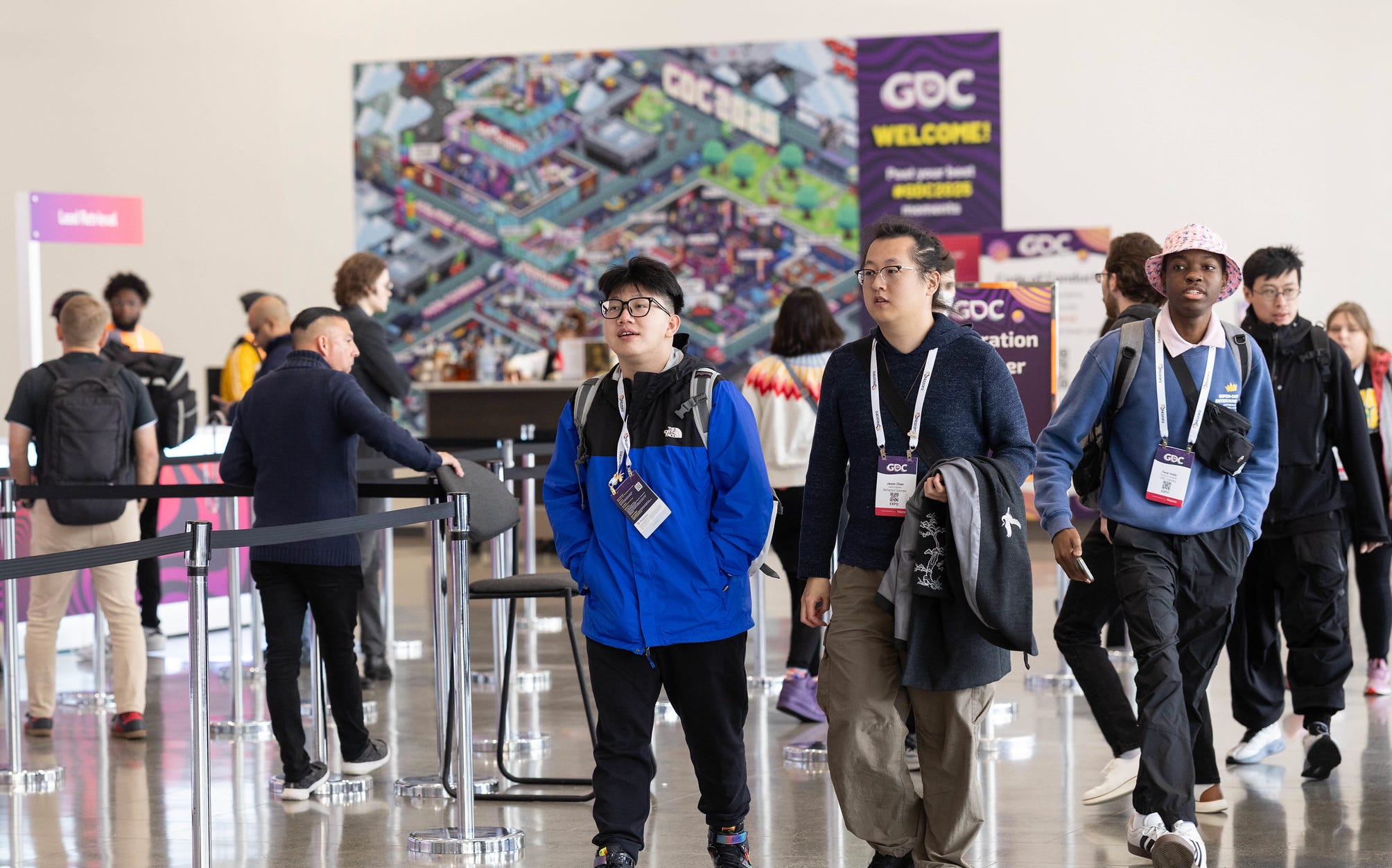
GDC 2026 is just over a month away, and it’s facing some of the biggest challenges in its nearly 40-year history.
The development conference has rebranded itself as a festival, and broadened its activities in a bid to increase attendance, improve its relevance and win back companies that have taken to meeting partners away from the show floor.
But on top of that, it’s dealing with increasing concerns from the international community over travelling to the US during a period of intense political and social change.
“It’s on the top of my brain, and I think it probably is for a lot of people because of the events of the past weekend,” said Mark DeLoura, executive director of innovation and growth at GDC.
“We haven’t seen any changes in the attendance numbers. We’ve seen a little up and a little down here and there in terms of the registrations that have come through so far. That said, it’s still something we’re thinking a lot about. I’m not sure there’s a lot we can do about it. One of the things that we knew we could do, and we did, was to release the content program a little earlier so that people who were coming would’ve more time to get their visas through the system.
“It is an open question. I think about it more in terms of the future of GDC than the present. If we are where we are, and there are people who are concerned about coming to the US, are there ways that we can come to them? There’s a question that’s in my mind. I think of GDC as being an event that’s for the community. So, if the community’s giving us particular feedback, we need to listen.”
One option the organisers continually look at is the prospect of leaving San Francisco.
“The game industry’s heart in the Untied States is San Francisco,” DeLoura said. “So, from that perspective, it immediately is like, ‘well, of course we’d be in San Francisco’. But there are other questions than ‘where is the heart of the game industry in the US’ that influence where we would want to have an event. Every year we have these conversations about, would it be better here? Would it be better there? San Francisco’s been a great partner. We have ongoing conversations with the city and state government about how they support the industry and how they support us, and us being there in a big way. But I always welcome the conversation.”
GDC says that 45% of registered attendees are new to the show, and that they’re coming from 69 different countries. It also name dropped some of the big attendees this year, including Amazon, Discord, Disney, Epic, Google, Meta, Microsoft, Nintendo, Nvidia, Roblox, Sony and Tencent.
“My opinion is that maybe next year is more of a make-or-break year”
- Mark DeLoura, GDC
Nevertheless, with big external challenges, plus the sheer number of changes being made this year, is this a make-or-break moment for GDC?
“My opinion is that maybe next year is more of a make-or-break year,” DeLoura answered. “Because we’re making a bunch of changes this year, and the next year if people don’t show up, it’ll be more of a signal than this year. But so far this year is looking pretty strong.”
Beth Elderkin, content marketing manager at GDC, added: “Change takes a little bit of time. The important thing for me is that we have so much support from our parent company over at Informa Festivals. They really believe in us and believe in what we’re doing, and they recognize that it’s going to take a little bit of time. We’re probably going to have hiccups here and there. But we’re not getting the top down of ‘if that doesn’t work, then it’s over’. We have space to experiment and have fun and try new things, which is really a blessing when you work in an event.”
52% of game industry professional believe generative AI is hurting the industry
GDC has revealed the results of its 2026 State of the Industry report, covering AI, layoffs, unionization, platforms, game engines, layoffs and more.
The survey changed this year, with customised questions for different groups, with developers, marketers, executives, investors and more only answering questions relevant to them.
One of the big areas of this year’s survey was on generative AI, which looked at how employees feel about the technology, who is using it, and how they’re using it.
“This year we really wanted to get deeper into the generative AI conversation,” said GDC’s content market manager Beth Elderkin. “The technology has been around for a couple of years now, and when we first introduced it into State of the Game Industry survey, it was in some senses a little bit more theoretical. But it has since exploded in popularity, not just among the game industry, but also amongst the general public. It’s something that people are very familiar with and make conscious decisions on how or whether to use them. So, we asked what tools they use, what they like to use them for, and we did find that most who do use these tools are using them for non-creative tasks.
“When it comes to more specific creative tasks like player facing features, that’s where we see less use and, in our open responses, where we saw more opposition.”
Here are some key AI stats from the survey:
36% of industry professionals use generative AI tools as part of their job. Men (41%) reported using it more than women (35%). And older workers (46%) more than younger ones (34%).
Game studio employees reported using AI tools (30%) less than those at publishing companies, support teams, and agencies (58%). Upper management (47%) uses AI tools more than those in more junior positions (29%).
The most common use of generative AI was for research/brainstorming (81%), followed by daily tasks (like writing emails) and code assistance (47% each).
Generative AI tools are used less for creative tasks like asset generation (19%), procedural generation (10%), and player-facing features (5%).
Overall, 52% said generative AI tools are being used at their companies.
78% of respondents work at companies with some form of internal policy on AI use, while 15% said there’s no policy and 7% were unsure.
52% think generative AI is having a negative impact on the industry. Those working in visual and technical arts (64%), game design and narrative (63%), and game programming (59%) had the most unfavorable views.
About 7% of respondents said generative AI is having a positive impact on the game industry, down from 13% in 2025.
The survey also tackled employee views on layoffs:
28% of respondents have experienced a layoff in the past two years. In terms of just US respondents, that increased to 33%.
Half of respondents said their current (or most recent) employers have conducted layoffs in the past 12 months.
47% of employed respondents don’t anticipate layoffs in the next year, while 23% do and 30% were unsure. People who had been laid off previously are more unsure (40%) about future layoffs.
74% of surveyed students said they’re concerned about their future job prospects in games
87% of educators said they either expect to see a negative impact on student’s finding jobs in the industry, or they’re already seeing it
GDC’s survey also dived into the conversation around unionization in the US, and concerns around immigration. The survey found:
59% of industry professionals (excluding solo devs) work at least 40 hours per week on average, and 11% typically work 50 hours or more.
82% of US-based respondents support game workers unionizing, 5% are opposed, and 13% are unsure.
Support for unionization was higher among workers making less than $200,000 per year (87%), those who’d been laid off at least once in the past two years (88%), and people younger than 45 years old (86%).
There were no 18 to 24-year-olds who were opposed to unionization.
For those outside of the US, GDC asked whether current immigration or gender identity policies have impacted current or future travel plans. 31% said they’ve cancelled travel plans to the US, and 33% are reconsidering future plans. The percentage increased to 47% for those who identify as LGBTQ+.
When it comes to non-US industry leaders and investors, 60% of them said current immigration policies have impacted their ability or desire to do business with US companies.
In terms of technology and platforms, GDC’s results revealed:
42% of developers are using Unreal Engine and 30% are on Unity. It’s the first time one engine has pulled ahead of the other.
PC remains the top platform, with 83% of surveyed developers currently making games for it and 80% saying they want to.
More developers are working on games for PS5 (47%) than Xbox Series X and S (40%). PlayStation also beats Xbox in developer interest, with 40% of respondents wanting to work on PS5 and 20% on Xbox Series X and S.
New for 2026, Steam Deck is the fourth most-used platform on the market, with 28% of developers making/optimizing games for it.
40% of developers said they’re interested in making games for Steam Deck, putting it on par with the Nintendo Switch 2 (39%).
Just 8%, fewer than 100 participants, said they’re working on VR/XR projects. 82% said they’re using Meta Quest / Horizon Store as the top platform for these experiences.
And finally, GDC asked 200 investors and business professionals about tariffs:
38% said US-based tariffs are impacting their expenses, revenue, or financial decisions. 39% said there’s been no impact, and 23% were unsure.
You can download the full report here.
Submissions for the Game Maker’s Sketchbook opens tomorrow (January 30)

Developers can submit artwork to this year’s Game Maker’s Sketchbook from Friday, January 30.
The project returns for its fifth year. It is designed to celebrate art in the video game business and raise money for charity.
Selected artworks will be displayed at the Play Days event at Summer Game Fest in June, and will be available to purchase via the Iam8bit store.
The Game Maker’s Sketchbook is the brain child of the Academy of Interactive Arts and Sciences (AIAS), Iam8bit and communications agency Fortyseven. Proceeds from the sale of the artwork go to the AIAS Foundation, which seeks to ‘advance an inclusive, interactive entertainment community through collaboration, education, and professional development.’
Submissions will be open from January 30 until Thursday, March 26, 2026. Artwork must be from a video game released since January 1, 2025.
We interviewed AIAS boss Meggan Scavio on this week’s edition of The Game Business Show.
Meanwhile…
Valve must face a £656 million lawsuit in the UK. The lawsuit says Steam’s revenue share is too high and negatively impacts consumers.
Capcom posted a jump in operating and net income, which rose by 75.1% and 68.6% respectively. It was driven by strong sales of legacy Resident Evil games. Meanwhile, Street Fighter 6 has surpassed six million sales, new mobile game Resident Evil Survival Unit has reached three million downloads, and Monster Hunter Wilds has finally surpassed 11 million units sold.
Amazon Game Studio boss Christoph Hartmann is leaving the company. It follows a shift in Amazon’s games focus towards its Luna streaming platform. The company has already ceased development of its MMO titles, although continues to invest in other game projects such as Tomb Raider.
Various Ubisoft unions, including STJV, CFE-CGC, CGT, Printemps Ecologique, and Solidaries Infortmatique, are calling for “a massive international strike” following the firm’s ‘reset’ plans. The unions want to strike for four days between February 10 – 13 to rally against cost cutting and the end of remote working.
Beat ‘em up specialist Dotemu’s new IP Absolum has been a hit, selling 500,000 copies worldwide.
Finally, two previously unreleased Virtual Boy games, Zero Racer and D-Hopper, are coming to Nintendo Switch Online.
That’s it for today’s edition. If you missed yesterday’s December Market Report, you can check that out here (paid subscribers only).
We’ll be back next week with interviews featuring Blizzard and Take-Two. Plus, we will dive into the US games market with Circana, and even predict what the biggest games of 2026 might be (outside of Grand Theft Auto 6).
Until then, thank you for reading.


